In films, painting and literature, theatre and music come together. But a film is still a film.
-Akira Kurosawa

Monday, November 21, 2016

Loving


Loving is a film from a promising Independent film director, Jeff Nichols.  He has seen success with such films as Take Shelter, Mud, and Midnight Special.  His latest film is getting some serious Oscar buzz and could get Nichols his first nomination.  The films stars Joel Edgerton and Ruth Negga, who are both getting Oscar buzz of their own.  The film centers on the true story of the interracial couple whose legal fight to have their marriage recognized in their home state led to the pivotal supreme court decision of Loving V. Virginia.

Richard Loving was a young white man who grew up in a largely black community in Virginia in the 50s.  He fell in love with Mildred and refused to let the world tell him who he could love.  He proposed on the land he just purchased to build their home on and they drove up to DC to get married there.  Mildred was pregnant, but that didn’t stop the police from pulling them out of bed a few weeks later and putting them both in jail.

That crime carried a one year prison sentence, but in lieu of that the judge gave them the very generous choice to either dissolve their marriage or leave the state and all their family and friends for twenty-five years.  They chose to leave and went to DC to live with some friends.  Mildred hated the city and didn’t want to have the baby away from her family, so they returned home, only to be arrested again shortly after the birth of their son.

Their lawyer got them off on a technicality and warned them not to return as that wouldn’t work a second time.  They moved to DC and had 2 more children and spent a number of years there.  Mildred was never happy in DC as she hated that her children had no grass to run around on.  She was inspired by the civil rights movement to right a letter to Bobby Kennedy explaining her situation.  That led to a call from an ACLU lawyer offering to take on their case.

He told them he would investigate all options and get back to them.  In the meantime, Mildred had enough of the city and worked with a friend of there’s a rent a home in a remote part of Virginia where they would be left alone.  The ACLU lawyers encouraged them to accept interviews and requests for photographs as a way to put the case in the public eye.  Richard hated the attention, but Mildred just wanted to be free to live with her husband, so they both agreed to the publicity.  The case was won by unanimous decision and allowed for interracial marriage not only in Virginia, but in the seventeen other states that still had it outlawed.

The actors in this film play their roles very well.  The characters are just simple country people that wanted to live their lives without trouble.  They were forced into becoming activists and seemed to do so reluctantly, at least on Richard’s part.  The performances while subtle seem to capture the personalities of the real life people they are representing.  

It’s a fascinating story and it kept me engaged, but it did feel like it lacked a sense of urgency.  There were moments where the films tried to show just how much was on the line for them, but those moments fell a little flat.  It felt like we were simply watching them live their life instead of following their struggles to fight for equality.  It was a more passive film than I would have expected for the subject that it covers.  I still think it is a fine film, but it lacks the purpose to make me ever want to revisit it.  All in all I’d recommend this film if civil rights is a passion of yours or if you’re a cinephile that wants to watch as many of the oscar films as you can.  This seems like a likely nominee at this point, but it’s still early so that can certainly change.

Rating 7/10

Sunday, November 20, 2016

Fantastic Beasts and Where to Find Them


The Harry Potter series was one that I was slow to become a fan of, in fact, they were 4 films in by the time I started watching the movies.  I learned to love them though and the wonderful characters of the wizarding world.  So when I heard they were making more films in that universe I was really excited.  When I heard the first one would be set in 1920s New York I was even more excited.  Fantastic Beasts and Where to Find Them, doesn’t fully live up to my high expectations.

Newt Scamander, played by Eddie Redmayne, shows up in New York with his case full of magical creatures.  We are introduced to a protest group trying to root out and destroy and witches, though they are largely seen as crazy since the magical world was still hidden away.  We also come to learn that there is some strange magical force roaming the city destroying buildings and causing mayhem.  One of Newt’s creature’s gets out in a bank and causes all sorts of mayhem for him and a no-mag (American term for muggle), Kowalski, who is just at the bank to get a loan and open a bakery.

The two men get their bags mixed up and a number of creatures get loose that they have to track down.  They are joined by a former magical law enforcement officer and her flirtatious sister.  This cast of characters, while not quite as lovable as the the Hogwarts kids, is still an endearing bunch that you can’t help but root for.  The plot is messy, but the conclusion is very satisfying and I think future films will be much better.

My biggest disappointment with this film is that it had a distinct lack of magical creatures.  The missing creatures plot line felt like a throw in compared to all of the broader storylines that were introduced.  Its a very different world than the one we know of from the Harry Potter films and that becomes very clear.  For as silly as some of the moments are the film takes itself incredibly seriously. 


There was one action sequence that was present in slow motion with very intense music, that I couldn’t help but laugh at because of how ridiculous it was.  It just seems so odd to try to add so much weight and sense of urgency to such a far-fetched and laughable situation.  The film was a good time, but little else.  Its certainly no Harry Potter, but I do think there is hope for the sequels to be better.  

Rating 7/10

Saturday, November 19, 2016

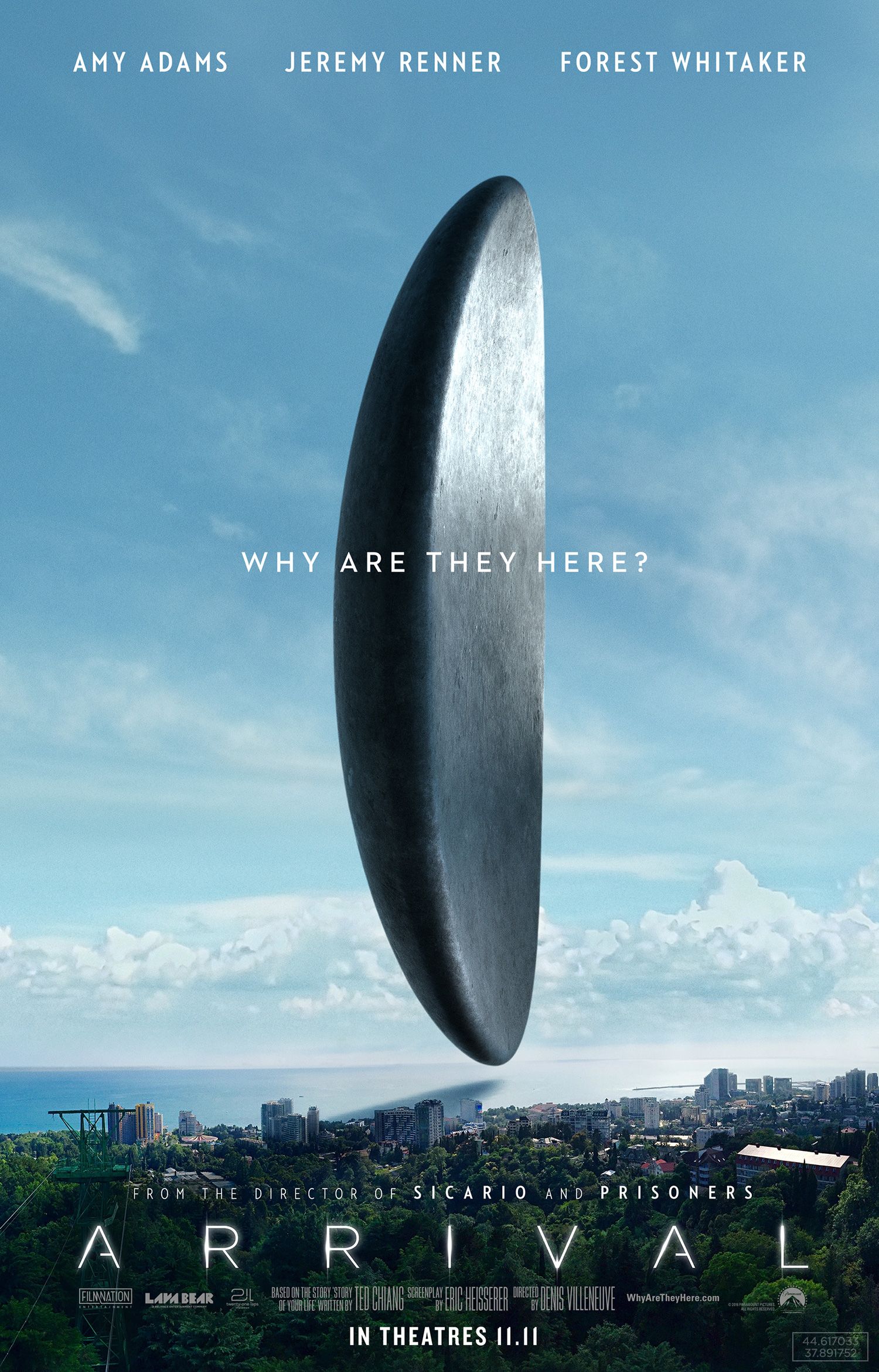
Arrival (2016)


High concept science fiction has found it’s way back to movies in the last few years with films like Interstellar, The Martian, and now Arrival.  What I’ve always loved about the sci-fi genre is it’s ability to tell very normal human stories in different ways, by using situations and technologies that are otherworldly.  Arrival tells a very intimate story about what would happen if an alien race just showed  up and invited us into their ships for a good conversation.

That’s what this film is.  It tells the story of a brilliant linguist who is brought in to try and communicate with this strange alien race.  She along with a scientist, who wants to discover how they got here and what we could learn from their technologies.  He quickly comes to understand how important understanding their language is and commits fully to helping decipher the strange symbols the aliens use to communicate.  

The scenes of them trying to figure out a way to understand what brought the aliens to earth are intercut with scenes of a the linguist, Dr. Banks, and her daughter.  These flashes of her life with her daughter clearly affect her emotionally and you begin to wonder whether she’s up to the job with which she’s been tasked.

The film moves a bit slowly, but you’re given just enough information to keep you wanting more.  It keeps you on the edge of impatience throughout it without ever pushing it too far.  Which exactly what a good suspense film should do.  It’s that fine line between keeping you on the edge of your seat, and dragging it out so long that you relax again resign to the fact that you might never get your questions answered.  Arrival skirts it perfectly and trust me the payoff is completely worth it.

I try to avoid spoilers with my reviews but this film neither caused me to break that rule, about putting in a little disclaimer when the spoilers would start, but it just didn't feel right, the simple fact that someone could ignore the warning and spoil the movie saddened me.  The real meat of this film and what it means lies in the spoilers, but I went into it knowing very little about what I was getting into and was blown away the incredible payoff that the director, Denis Villeneuve presented to us.  So this is one of my shortest reviews because there's just so little I can say about it without spoiling the ending.


This is easily my favorite film of the year and I will happily discuss it in more detail with anyone else who has seen it.  So for this film I will simply encourage anyone who’s seen it to comment on this article and we’ll get all the spoilers out there.  Or if you happen to see me in real life we can talk about it there too.  This is a film that just cries out for further discussion and it carries as strong of a recommendation as I can give.  It’s what science fiction should be all about.

Arrival 10/10

Friday, November 18, 2016

Rashomon (1950) and Harakiri (1962)


I wrote about the great Japanese director Akira Kurosawa just the other day.  And spoke of his philosophy and the impact his films had on me.  However, beyond just his impact on me, his films were incredibly influential for the world of film as a whole.  George Lucas and Francis Ford Coppola were inspired by him and used elements of his films in some of their own and Sergio Leone outright stole the story of A Fistful of Dollars from Kurosawa’s Yojimbo.  Some influences are a little more subtle, like how Masaki Kobayashi, another Japanese director and friend of Kurosawa, borrowed from the story structure of Rashomon in his masterpiece Harakiri.

The stories are very different and the structure is used for a very different effect, but both films involve people sitting around telling stories that a form a larger story.  In Rashomon, it is used to show the perspectives of the different people involved in a crime.  In Harakiri, we are given small pieces of a story that gradually builds the tension of the situation in which the storytellers find themselves.

Rashomon is the film responsible for opening up the impressive Japanese film industry to the rest of the world.  The studio that made it did so entirely because of Kurosawa’s reputation, as the script confused them and they didn’t think it would make any money.  In Japan, it wasn’t that successful, but a representative of the Venice Film Festival saw the film and convinced the studio to submit it.  It went on to win the top prize of the Golden Lion and the critics choice award there.  From there it spread quickly around the world winning awards all over the place and even picked up an Oscar Nomination for best Art Direction.

The film opens on three men taking shelter from a torrential downpour at the famed Rashomon gate.  A woodcutter and a priest sit staring off into space trying to comprehend exactly what just happened.  They were both witnesses at a trial of a famed bandit who was accused of killing a samurai and raping his wife.  They both tell their stories and then explain the stories of the bandit, the woman, and even of the dead man who communicates through a medium.  All the stories are vastly different and between each telling of the story, the three men discuss which might be the truth.  This concept of multiple tellings of the same story being very different probably sounds very familiar, but rest assured this is what inspired all those copycats, in fact, the Rashomon effect is a real thing, look it up.

Harakiri has a slightly more traditional narrative, as the stories being told start to form a whole narrative.  This is a great example of a nonlinear storyline that would become popular much later.  The film is set a few years into a time of peace in Japan.  The clans are no longer warring and the demand for Samurai is greatly decreased.  Samurai were of too high a class to take jobs as laborers which left many without anyway to survive.  The story of a samurai going to a clan lord asking for an honorable place to commit ritual suicide (Harakiri) instead of living in poverty and disgrace spread across Japan.  In the story the great Lord was so impressed by his determination and conviction that he offered the Samurai a job within his clan.

Other Samurai followed suit only to be turned away with some money in their pockets.  The disgraceful act of feigning a desire to commit Harakiri only to get money was greatly looked down on by the great Lords.  Our story begins with a grizzled Samurai making just such a request.  He is cautioned with a story of a young Samurai making the same request and being forced to follow through with the ritual suicide.  Through further stories we learn of an existing relationship between the young samurai from before and the older one here in the present.  What follows is a tense story about the foolishness of a legalistic honor code and what that meant for all the out of work Samurai out in the world.

Rashomon can only be called a bit of an experiment with storytelling, in that it tells the same story in different ways.  There are so many techniques used that seem different and a bit off-putting.  Like when we see the trial, testimonies are given right to the camera with no shot of the judge at all.  Or in the woods when they are discussing the crime itself he’d mix in shots with the camera pointed directly at the sun.  One thing he did in the woods was try to make the scene feel like classic silent films and he succeeded both in the look and the score that played over the scenes.  This is not a film for everyone, but it’s importance in cinema history cannot be ignored and if you are at all curious about the history of film it’s definitely worth seeking out, or if you just like the idea of this kind of storytelling.

Harakiri on the other hand is a much more traditional storyline, that can be enjoyed by anyone willing to give subtitles a chance.  This film is what I like to call a slow burn.  The tension builds slowly and deliberately, but the story is so fascinating and it leaves you with just enough questions that you are fully involved throughout.  The acting is excellent and the themes are clear.  I’d consider this a fantastic introduction to the world of Japanese cinema.  

Rashomon 9/10
Harakiri 10/10

Wednesday, November 16, 2016

My Philosophy on Film


Akira Kurosawa, was the Japanese director, who opened the door on Japanese cinema to the rest of the world.  Before his films received critical acclaim worldwide, one of the greatest film industries in the world was widely unknown to the outside world.  He inspired numerous films and filmmakers, and it’s safe to say that movies would not be the same without his influence.  He also happens to be one of my favorite filmmakers, largely because his philosophy of what films can and should be so closely matches my own.  So when I decided I wanted to give my audience (small as it may be) an idea of what I look for in a film, I thought I’d take the opportunity to use Kurosawa and his films as an example.

One of this great director’s defining characteristics is his focus on the script.  Like myself he sees the script as the most important part, “With a good script a good director can produce a masterpiece; with the same script a mediocre director can make a passable film. But with a bad script even a good director can’t possibly make a good film.”  I think for Kurosawa this idea spawns from his absolute love of literature.  From an early age he was absorbing literature of all sorts, and it certainly shaped his career.

He was constantly inspired by existing literature in the scripts that he wrote.  In films like Throne of Blood and Ran, he took Shakespeare and adapted it to Japanese culture.  While both are clear adaptations of Macbeth and King Lear respectively, he instructed his actors to model their facial expressions after the masks of Japanese Noh theater.  And he set the films in the world of Samurai.  What results is a completely unique interpretation of Shakespeare that somehow enhances your understanding of the classic plays.  

At this point I’m just going to post some Kurosawa quotes as they match so perfectly with what I think makes for good writing.

“In order to write scripts, you must first study the great novels and dramas of the world. You must consider why they are great. Where does the emotion come from that you feel as you read them? What degree of passion did the author have to have, what level of meticulousness did he have to command, in order to portray the characters and events as he did? You must read thoroughly, to the point where you can grasp all these things. You must also see the great films. You must read the great screenplays and study the film theories of the great directors. If your goal is to become a film director, you must master screenwriting.”

“I‘ve forgotten who it was that said creation is memory. My own experiences and the various things I have read remain in my memory and become the basis upon which I create something new. I couldn’t do it out of nothing. For this reason, since the time I was a young man I have always kept a notebook handy when I read a book. I write down my reactions and what particularly moves me. I have stacks and stacks of these college notebooks, and when I go off to write a script, these are what I read. Somewhere they always provide me with a point of breakthrough. Even for single lines of dialogue I have taken hints from these notebooks. So what I want to say is, don’t read books while lying down in bed.”

His goal was honesty in his characters and he put hours of work into developing the characters beyond anything he might need for the film just so that they would be more honest.  He learned that collaboration with other writers was another great way to create an honest character because it allowed him to separate his personal feelings for the characters from the direction that character would really act or react.  These methods were on full display when he and three other writers spent a month in seclusion at a hot spring resort writing the script for Seven Samurai.  They came away with an enormous script and Kurosawa personally had 6 notebooks of information just on the characters.  He then insisted that the actors playing the farmers live and work as the families they were supposed to be in the film.

His dedication to honesty in his characters and his stories is a defining feature of his career and one that I think makes for excellent cinema and excellent writing in general.  There was a devastating earthquake in Japan when he was just 13 and his older brother took him to see the devastation.  Young Akira wanted to look away from the devastation as it was graphic and brutal, but his brother wouldn’t allow it.  It clearly had an impact as he later said, “Being an artist means not having to avert one’s eyes.”  To me, this honesty and open-mindedness is essential in filmmaking.  You have to be open to any and all ideas, because you may have to write a character where an idea you find offensive or uncomfortable is a key element in who they are and what they do.

I have a Kurosawa quote on the top of my blog as to me it perfectly encapsulates my overall feelings about film.  This is the longer version of that quote, “For me, filmmaking combines everything. That’s the reason I’ve made cinema my life’s work. In films, painting and literature, theatre and music come together. But a film is still a film.”  No filmmaker more encapsulates this idea than Kurosawa.  He was trained as an artist and studied literature at a young age.  He applied for a job at a film studio on a whim, but rose quickly through the ranks due to his understanding of so many of the art forms that make up the medium of film.

Kurosawa was a perfectionist and often went over budget and well past the scheduled shooting time in order to perfect his films.  This caused difficulty with Japanese studios that had to start cutting costs and Kurosawa was forced to seek out funding in other places.  He went long periods of time without making films and at one point thought he had made his last film.  So instead he decided to paint the images of the film that he had in his head.  The series of paintings that he made were eventually used as frames of a storyboard for his 1980 film Kagemusha.  The visuals of the film are incredible and if you see his paintings you can understand why.

His experience with literature helps him craft excellent stories and characters.  His experience in art helps him create beautiful images on screen.  Much of his work was in black and what, but he still developed dynamic images through the staging of the shot and how it’s framed.  A popular trend now is 3D in film, which essentially accentuates the depth of field that films naturally have.  Kurosawa like many other great directors constantly found a way to add incredible depth to each and every shot.  It’s my firm belief that each shot of a film should be considered it’s own work of art and Kurosawa is one of those filmmakers that really makes you feel like that is true.  His dynamic editing and filming methods only add to the artistry and are unique elements to the medium of film.  It’s clear this man brought an artistic and literary eye to each and everyone of his films and you can really see that influence.  There’s a lot more I can probably say about his work, but I think I’ll just leave with a series of his paintings that were used to create the images in his film Kagemusha.


Tuesday, November 15, 2016

Kubo and the Two Strings


Kubo and the Two Strings is the fourth stop-motion animation film from Laika studios, the other three being Coraline, ParaNorman, and The Box Trolls.  I have yet to see Coraline, but their most recent effort far exceeds either of their last two films.  The story is simple and somewhat predictable, but the characters are fantastically loveable.  The simplicity of the story works well as it allows the viewer to focus on the beauty of the design of the characters and the world in which they live.

Kubo is a young one-eyed storyteller, who spends his days telling stories to the townspeople, using magic to animate origami to show what is happening in his stories.  Each night he races back to the cave he lives in with his mother.  This is where we learn that the great samurai, whose story he was telling the townspeople, was actually his father, and the villainous Moon King of his story was actually his mother’s father.

His mother warned him to never be out at night as the Moon King would find him and come to finish the job and take Kubo’s other eye.  Inevitably Kubo stays out after dark and is immediately found by his evil aunts who try to capture him and return him to their father.  He is saved by his mother, who gives her life and the last of her magic to animate the wooden monkey charm that Kubo kept on him, in hopes that the monkey would protect him.

Kubo is determined to try and defeat the Moon King so he wants to seek out the 3 pieces of mystical armor said to be the only way to defeat him.  The Monkey is hesitant but agrees.  Along the way they are joined by an animated origami samurai and a samurai with amnesia who was cursed to become a beetle-like man.  

This odd bunch travel around facing various monsters and growing closer as a result.  The characters are incredibly endearing and you can’t help but fall in love with all of them.  Things get more harrowing as the film draws to its conclusion, but the conclusion is incredibly satisfying and sweet.  It really should be incredibly corny and sappy, but somehow it doesn’t feel that way.

The design of the film is the true star, but the voice talent involved does an excellent job of bringing life to the characters.  Charlize Theron, Matthew McConaughey, Rooney Mara, and Ralph Fiennes all help bring the characters to life.  There’s even a small role for George Takei!  It’s an excellent film and exactly the kind of film that children should be watching as it does not sacrifice quality in an attempt to dumb the film down to a child’s level.  Too often Hollywood fails to give children enough credit and this film breaks that trend in a big way.  It’s good enough to be enjoyed by the whole family.  

Rating 9/10

Sunday, November 13, 2016

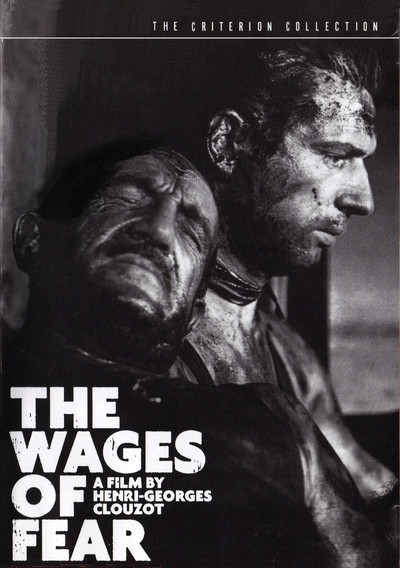
The Wages of Fear (1953) vs. Sorcerer (1977)


Along with individual reviews I will likely do a series of duel reviews of films that have similar themes or ideas, or are just in some way reminiscent or inspired by each other.  This is one of those posts.  Today I’ll be taking a look at two films both of which were adapted from the 1950 French novel by Georges Arnoud called the Le Salaire de Peur, which literally means, The Salary of Fear.  The first is the 1953 thriller, of the same title, made by the great French Director Henri-Georges Clouzot, the English title was The Wages of Fear.  The second is the confusingly  titled 1977 film, Sorcerer from the American director, William Friedkin, known mostly for The Exorcist.  

Both films have their merits and essentially tell the same story, but there are some unique differences.  The story revolves around a small South American town that exists economically thanks to an American oil company.  It also serves as a haven for people from all around the world who have no where else to go.  There is very little work and many of these men are stranded without official papers or enough money to leave town.  

An opportunity arises when an explosion causes an oil fire at a well 300 miles away.  The only way to put it out is with an explosion of nitroglycerin.  However the nitroglycerin must be transported all 300 miles of the trip by truck, and there is no time for special equipment to secure it properly.  The oil company doesn’t want to sacrifice their own employees to this suicide mission, so they take the job to these stranded foreigners and offer them a large sum of money to accept the suicide mission.

Four men are selected to drive two trucks filled with this incredibly unstable cargo over rough terrain.  Friendships are developed and tested as they meet each obstacle as it comes in hopes of finally finding a way out of this tiny town that has become their prison.

Despite having the same source material the differences in the films are stark.  In the original film, Clouzot, begins the story already in the little South American village and quickly shows us the state of life for these men without a country.  A man in a white suit steps off a plane into this little town and has to bribe the customs officer to let him in.  He meets a fellow frenchman near the local saloon and they instantly connect and become fast friends.  This newcomer, called Jo, is the only character who even has a backstory as far as we are concerned.  And that backstory is given to us in tiny revelations that we can piece together to know that he is a criminal who had to flee for his life and is now stuck in this town with no money.

We can only assume that the other men are in similar circumstances, however in Friedkin’s Sorcerer, the first 40 minutes of the movie is spent on nothing but backstory.  We get to see where each man comes from and what brings them to that town.  What the American fails at is making the characters relatable.  Yes, we have a glimpse at where they came from, but we get very little information about who they are in their everyday lives.  Whereas in the original French film, we are able to get to know the characters in their everyday lives in this tiny town.  We see the lives that they live and the desperation that is bred in this town where work is limited and difficult.  Clouzot makes their decision to join this suicide mission completely understandable.

Then the relationships of the characters are far more developed in the original, making their interactions during the stressful situations all that much more interesting.  The two Frenchmen who share a truck see their friendship fall apart, as Jo, the master criminal who convinced Mario, to do the job, gets the jitters, as his co pilot calls it.  He breaks down and his nerves get the better of him.  His friend is sympathetic at first, but gets increasingly agitated as the journey goes on.  The men in the other truck have lived in the same town as Mario for a long time and they all knew each other well, Jo becomes increasingly isolated and left out as he refuses to engage in anything that might help them complete their mission.

At this point you probably realize which telling of this story I prefer, the French film builds better characters, but also makes the tension of this situation palpable.  You feel what they feel.  You share the limited space in the cab with the men and feel the heat that that they feel.  Where the Friedkin film creates drama with noise and big set pieces, Clouzot creates tension through the quiet moments, giving nothing else to think about, but what might happen if they hit a pothole in just the wrong way.

Now this isn’t to say that Friedkin’s film is a bad one, in fact, it’s quite good, it’s just an incredibly different take on the story and one that fell a little flat for me.  Friedkin’s other very well known film besides The Exorcist is The French Connection, which I had a similar response to.  There is little fault I can find with either this film or The French Connection, but something about them just left me feeling nothing.  Now I will admit this is actually a stylistic approach that just doesn’t work for me and was actually the popular style of the 1970’s when those films were made.  American thrillers of the time told great stories, but they told them to us and didn’t allow us to experience the events of the film with the characters.  The immersive quality of Clouzot’s original is what takes it elevates it far beyond what Friedkin was able to accomplish.

The story itself is a brilliant one that will keep you on the edge of your seat, and each film does an interesting job telling that story.  I’d highly recommend one over the other, but if you’re not one that enjoys subtitles, I might recommend Sorcerer, as the subtitles are limited mostly to the first 30 minutes and the majority of the dialogue is in English.  But if you simply want to watch the better film, then go find The Wages of Fear, and I don’t think you will be disappointed.


P.S. I can’t help but think that the studio behind Sorcerer was intentionally deceitful.  This was Friedkin’s followup to the runaway hit The Exorcist.  I’m positive their hope was that the title would make people think it was a similarly creepy horror film, as the film itself has nothing in it that would make a title of Sorcerer make any sense at all.  Just goes to show you that studios really will do just about anything to capitalize on a previous success.

The Wages of Fear   9/10

Sorcerer  6/10